

A first book is exciting because almost every decision feels possible. It is also difficult for exactly the same reason. Successful beginners do not know every answer before they start; they create enough boundaries to keep moving when the initial rush fades.
1. Decide what finishing means
“Write a book” is too vague to guide a Tuesday evening. Define the project: a 70,000-word standalone novel, a short practical guide, or a picture-book dummy with twelve spreads. The definition may change, but it gives you a finish line.
2. Write a one-paragraph north star
Describe the central person or reader, the problem, the stakes and the transformation. Keep it where you can see it. When a subplot or fascinating research trail appears, ask whether it strengthens that promise.
3. Study the shelf you want to join
Read recent books aimed at your likely audience. Notice length, pacing, point of view, chapter size, cover language and the kind of ending readers receive. Genre knowledge does not remove originality; it helps you understand the conversation you are entering. Our guide to book genres is a useful starting map.
4. Build a route, not a prison
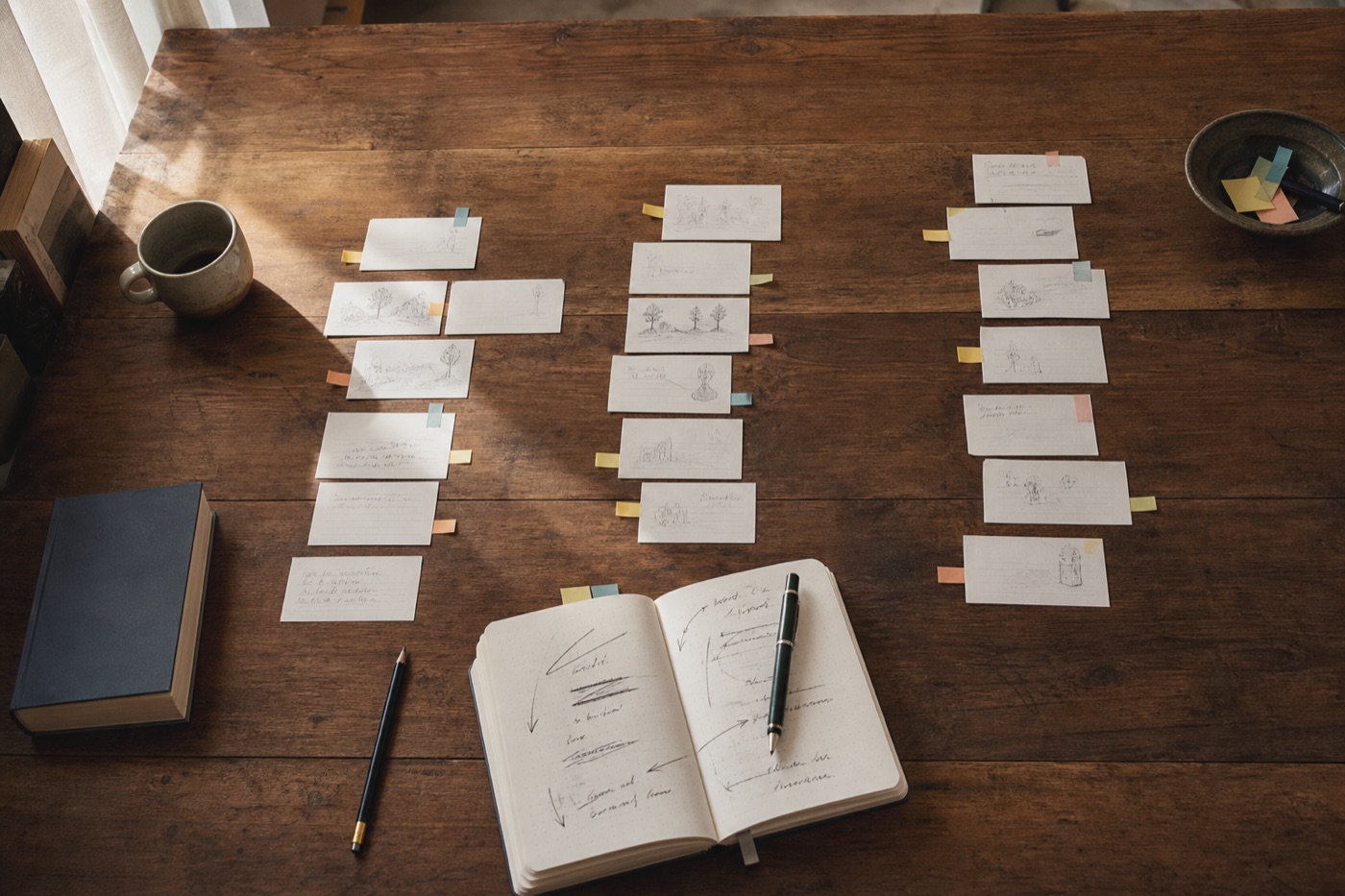
Plan a few irreversible moments: the event that starts the story, the choice that changes its direction, the darkest consequence and the final decision. You can discover the roads between them while drafting. If you enjoy deeper preparation, try the framework in our plot guide.
5. Create a minimum writing habit
Set a version of the habit you can complete on a bad week. It might be twenty focused minutes three times a week. Once that routine is trustworthy, add ambition. A modest schedule repeated for six months beats a heroic weekend followed by silence.
6. Draft forward
Use placeholders for facts, names and transitions you can solve later. Keep a “fix in revision” list beside the manuscript. Early polishing feels productive, but it can prevent you from learning what the book actually needs.
7. Protect continuity without overbuilding
Record only details that help the next scene: what a character wants, what they fear, what they know, and how relationships change. A compact character sheet is more useful than fifty fields you never consult.
8. End each session with an open door
Before stopping, write one sentence about what happens next or leave the scene a few lines before the obvious continuation. Returning becomes easier because you are not facing a completely blank decision.
9. Let feedback arrive in stages
Your first reader is you, after a little distance. Solve missing scenes and broken motivations before asking beta readers about pace and emotional impact. Copyediting comes later. Clear stages prevent contradictory advice from overwhelming the draft.
10. Learn production early, schedule it later
It is sensible to understand editing, covers, formatting, ISBNs and distribution before you finish. It is not sensible to redesign a launch graphic every time chapter six becomes difficult. Keep a production list and return to the current manuscript milestone. When the draft is ready, use our publishing roadmap.
Your first four weeks
- Week one: define the reader, book promise and scope.
- Week two: identify six to ten major story or chapter moments.
- Week three: test three realistic writing appointments.
- Week four: review what made returning easy or hard, then adjust the system.
Your first book does not need the perfect process. It needs a process sturdy enough to survive uncertainty. Finish one manageable decision, then give yourself the next.
Turn ambition into a forecast you can revise
Choose three working numbers: approximate draft length, sustainable weekly output and a buffer. A 75,000-word novel at 3,000 words per ordinary week needs twenty-five writing weeks. Add five buffer weeks and you have a thirty-week draft window. This is not a contract with yourself; it is a model. Update it after three weeks of real evidence.
Prototype the voice before building the whole book
Write one representative scene containing dialogue, action and a private decision. Try the same 300-word moment in first person and close third, or past and present tense. Read both aloud the next day. You are not choosing the version with the fanciest sentences. Choose the viewpoint that gives you the right access to information and can survive an entire book without constant explanation.
| Pass | Question | Output |
|---|---|---|
| Discovery | What book am I promising? | A two-sentence premise and one sample scene |
| Route | Which changes cannot be skipped? | Ten to fifteen major beats |
| Draft | What happens next because of this? | A complete, imperfect manuscript |
| Development | Does the chain of decisions hold? | A structural revision map |
| Line work | Is every paragraph doing its job? | A clean reader-facing voice |
A humane fallback for disrupted weeks
Do not “catch up” by doubling tomorrow’s quota. That converts one missed session into a new reason to avoid the desk. Keep three session sizes: a full 60-minute scene, a 25-minute continuation, and a 10-minute bridge in which you write the next scene’s entry, turn and exit. All three preserve momentum.
First-book questions with useful answers
Do I need to know the ending?
You need enough direction to make the next decisions meaningful. A provisional ending is often sufficient; it can change when the draft reveals a better consequence.
What if my word count is low?
Track completed scenes and decisions as well. A week that solves the central motive may be more valuable than 5,000 words that later disappear.
Should family read the first draft?
Only if they understand the genre and can answer specific questions. Enthusiasm is welcome, but useful feedback requires a clear brief.