

A plot is not the list of things that happen. It is the pattern of consequences that makes one event lead to the next. The right structure for a domestic novel may look nothing like an action thriller, but both create a meaningful expectation and keep changing what the protagonist can do.
Write the causal spine
Summarise the story using “because” and “therefore.” When you rely on “and then,” investigate the missing decision. Coincidence can start trouble; it rarely satisfies when it solves trouble.
Connect external pursuit to internal defence
Give the protagonist a visible goal and a private strategy that once protected them. The plot becomes personal when pursuing the goal repeatedly exposes the limits of that strategy. Use a character sheet to identify fear, false belief and resources.
Make turning points close doors
A revelation is only structural when it changes available choices. Useful anchors include the disruptive event, first binding decision, midpoint reframe, worst consequence and final defining choice. Place them where the story needs them; percentages are diagnostic tools, not laws.
Test scenes by change
At the start, someone wants a concrete outcome. Opposition creates tactics. At the end, knowledge, power, commitment, danger or relationship has changed. Quiet scenes can pass this test. Busy scenes can fail it.
Give subplots a job
A subplot should complicate the main goal, test the theme, develop a relationship or provide a resource with a later cost. Let it collide with the central story at crucial moments. If it can be removed without changing any major choice, its purpose is unclear.
Control tension through information
Tension depends on what readers expect and what they do not know. Alternate anticipation, partial answers and changed questions. Speed is only one tool. A slow negotiation becomes intense when both sides have something precise to lose.
Revision questions
- Does the protagonist cause major developments?
- Do costs become more personal and difficult to reverse?
- Does the middle change direction or meaning?
- Does the low point grow from earlier choices?
- Does the climax test inner and outer conflict together?
- Is the final state measurably different from the opening?
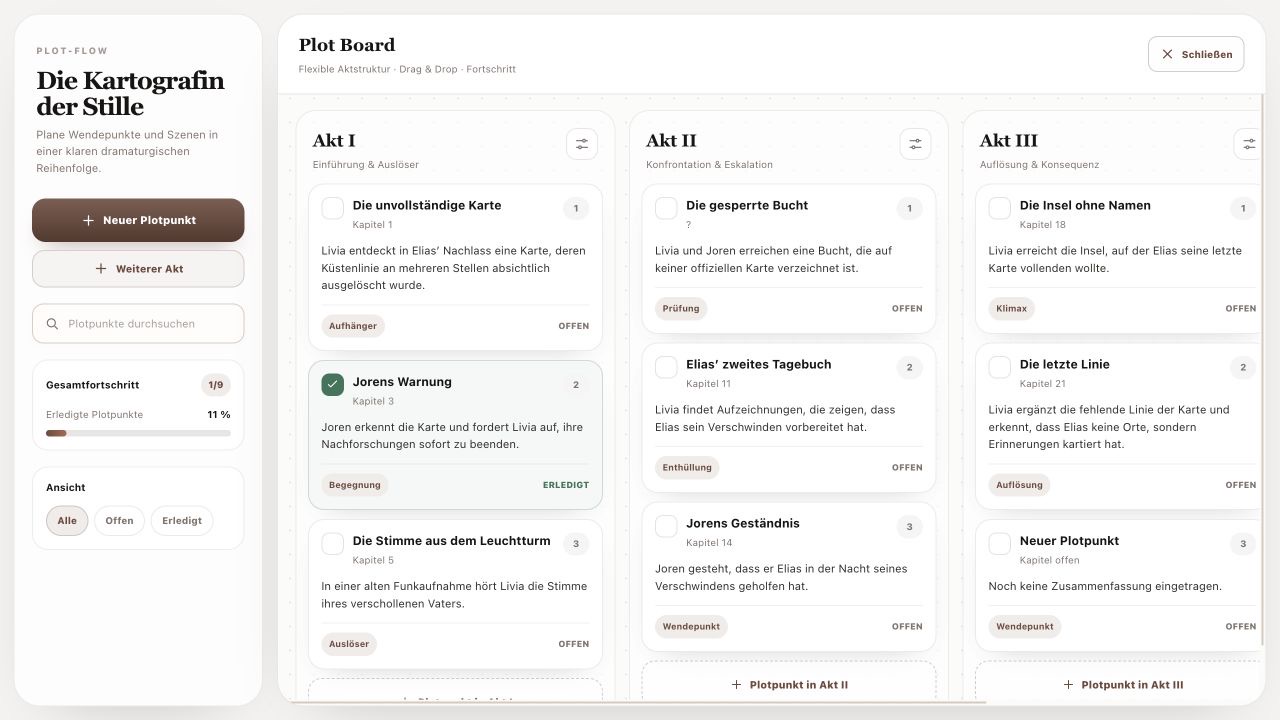
ManuBook lets you keep plot points, scene cards and character information with the manuscript while the structure evolves. For an applied workflow, continue with how to plot a novel.
A plot point changes the available future
Events become plot when they alter knowledge, leverage, desire or risk. Give every major beat four lines: trigger, chosen response, immediate result and door that closes. The closed door matters. Without it, the protagonist can reset and the reader feels motion without accumulation.
| Test | Strong evidence | Weak signal |
|---|---|---|
| Cause | The next beat happens because of the previous choice | The calendar advances |
| Agency | A decision trades one value for another | The hero receives another instruction |
| Escalation | An option disappears or a cost compounds | The threat repeats more loudly |
| Midpoint | New understanding changes strategy | Information arrives but behaviour stays identical |
| Climax | The central choice proves the arc | A stronger ally solves the problem |