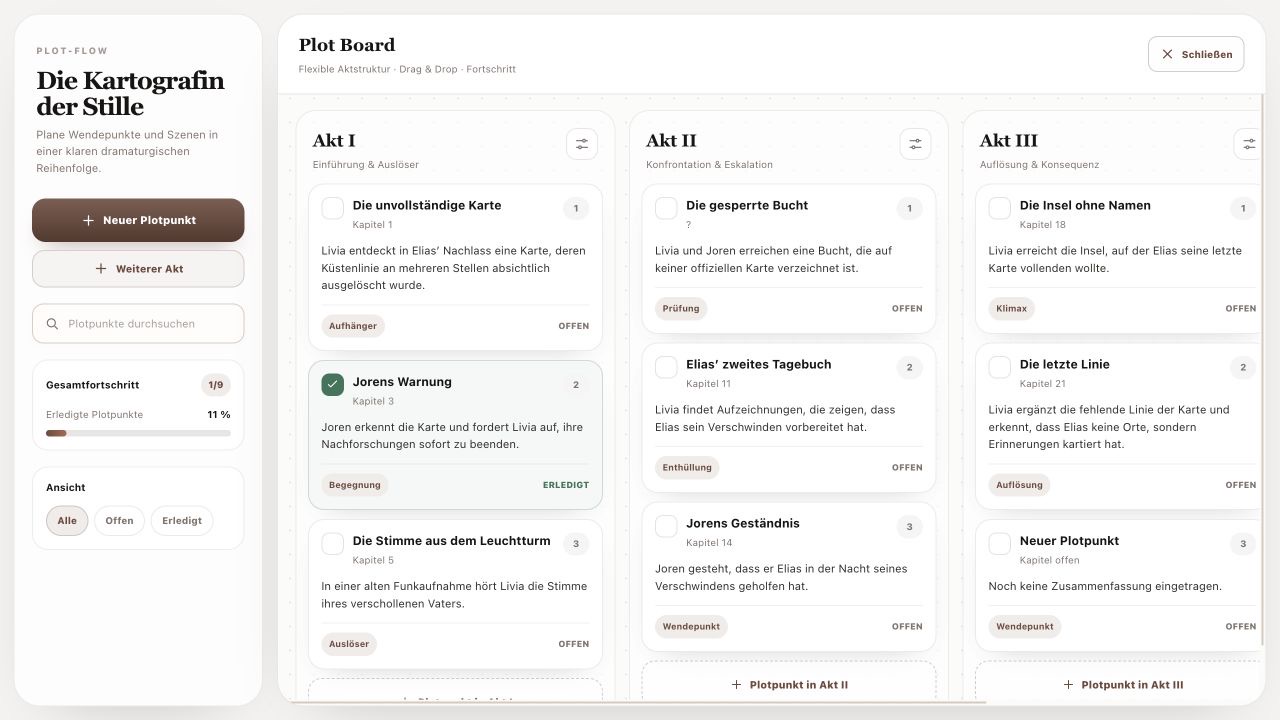

Novel planning works best as a set of useful decisions, not a performance of certainty. The map should reveal missing bridges and expensive choices while leaving room for discoveries that only prose can make.
Write the dramatic proposition
Name the protagonist, pursuit, opposing force and consequence in one sentence. Then write the emotional proposition: what belief about self or others will the story test? Keeping both prevents an active plot with no inner movement.
Sketch the ending pressure
You do not need the final choreography. Decide what kind of choice the climax demands and how the protagonist will be capable—or incapable—of making it. This gives the opening a meaningful opposite.
Design opposition as an intelligent system
An antagonist, institution, environment or internal compulsion should adapt. Give the opposing force resources and reasons. Build both sides with character-pressure notes rather than assigning one side generic evil.
Place structural anchors
Use five provisional points: disruption, committed action, midpoint reframe, consequence of the old strategy and climactic choice. Ask what becomes impossible after each one. If nothing closes, the beat may be information rather than a turn.
Bridge anchors with scene cards
Each card needs viewpoint, immediate desire, resistance and changed outcome. Keep cards brief so they remain movable. Group them into chapters after you can see the rhythm; chapter boundaries serve the reader and need not match one scene each.
Thread subplots through decisions
Track relationship and thematic threads in separate colours. Make them alter a main-plot choice rather than waiting politely in the background. Use the tests in the strong-plot guide to remove decorative detours.
Leave discovery zones
Do not outline every reaction and transition. Mark areas where you know the destination but want to discover the route in prose. Update the plan when a scene reveals a more credible motivation.
Audit the board
Scan for repeated outcomes, missing setup, long absences and a passive protagonist. Retell the plot aloud in five minutes. Any moment requiring “it just happens that…” deserves a causality check.
ManuBook keeps the plot board, character profiles and chapter structure together, so the outline can evolve beside the manuscript. Plan enough to create momentum, then let the draft earn its surprises.
Convert beats into scenes you can enter
“Research at the archive” is not a scene plan. Add viewpoint, entry objective, active resistance, reversal and exit condition. Now the blank page has pressure: the researcher can get the document, protect their identity or preserve the archivist's trust—but not all three.
| Card field | Make specific | Avoid |
|---|---|---|
| Entry | Viewpoint, place, time and immediate objective | General chapter mood |
| Resistance | An active force with its own interest | Random delay |
| Turn | Changed meaning, knowledge or leverage | More volume without change |
| Exit | Gain, loss and downstream question | Resetting to the opening state |

Plan in passes with different jobs
- Spine pass: map ten to fifteen irreversible changes.
- Scene pass: add goal, resistance, turn and exit.
- Rhythm pass: inspect revelations, recovery space, viewpoint distribution and chapter endings.
Do not solve gaps with travel and explanation merely to make the board look complete. Label the missing causal bridge. A visible problem is easier to solve than a placeholder scene disguised as progress.