

An author website is not a digital brochure you finish once. It is your stable home between launches: the place a reader can confirm a series order, a librarian can find event information and a journalist can download accurate details. Its advantage is ownership, not size.
Choose one primary audience for the homepage
Most author sites serve readers first. Put your name, genre promise and best current entry point above the fold. A new visitor should understand the reading experience within seconds. Secondary routes for press, rights or events can remain easy to find without competing with the main action.
Give every book a permanent page
Create a stable URL for each title or series. Include the cover, a concise hook, description, edition details, accessible sample and purchase choices. Add series order explicitly. These pages are more useful for search and sharing than sending everyone to a retailer listing you cannot control.
Build a small information architecture
- Home: positioning, featured book and next action.
- Books: browsable titles with individual detail pages.
- About: reader-relevant biography and approved photographs.
- News or events: only if you can keep it current.
- Contact and legal pages: clear routes for readers and professional enquiries.
Create content around genuine questions
Useful search content might explain a series timeline, historical research, discussion questions or the setting behind a novel. Give every page a specific title and description, one clear heading hierarchy and internal links to relevant books. Compress images, include meaningful alt text and make mobile performance a requirement.
Treat the mailing list as a relationship
Tell subscribers what they will receive and how often. Offer a relevant reason to join, then deliver it promptly. Keep consent and unsubscribe handling appropriate to the laws that apply to you. Unlike a follower count, a well-managed mailing list gives you a direct launch channel. Our book-marketing guide shows how it fits into a broader plan.
Test the whole reader journey
Open the site on a phone over a slower connection. Follow a book link, download the sample, subscribe, find the confirmation and return to a retailer. Check keyboard navigation and contrast. Remove dead buttons and social icons you do not maintain. A smaller complete journey outperforms a feature-rich maze.
Use ManuBook as a polished author profile
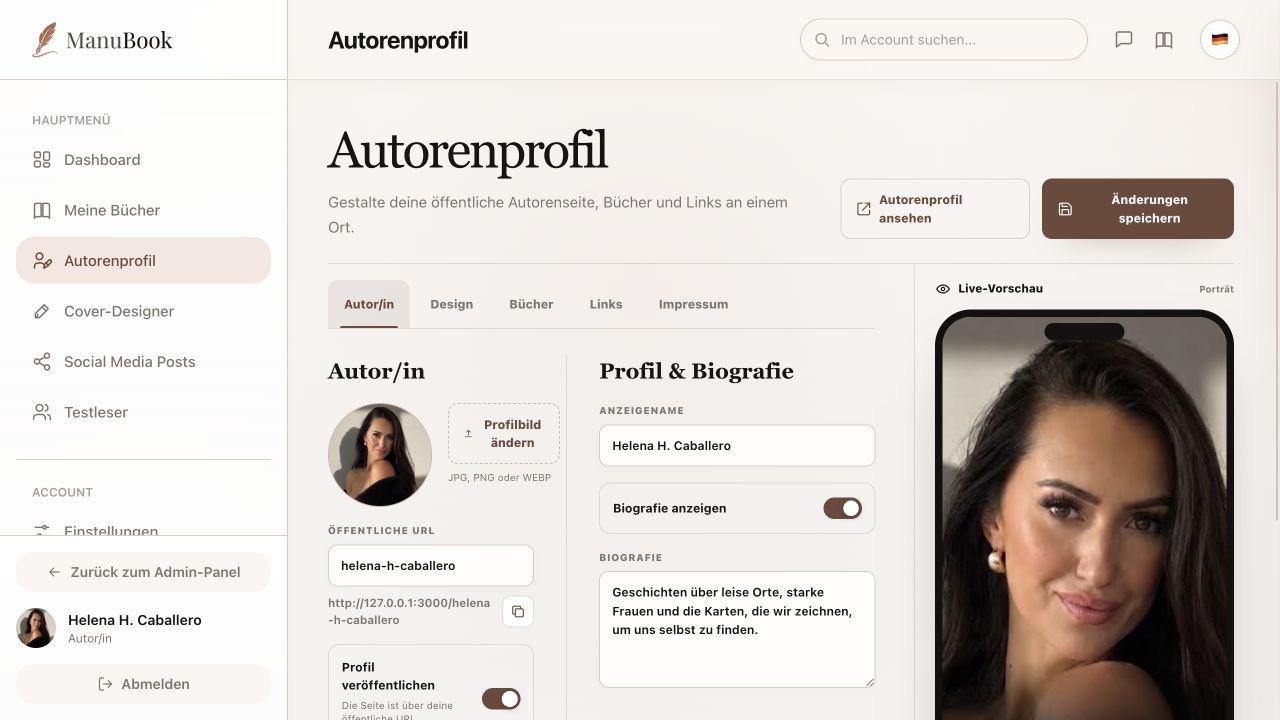
ManuBook can publish a personal profile URL that brings your author identity, covers, book information and important links together. A separate CMS may still suit a large blog or press archive. Whichever route you choose, keep the book data consistent with your publishing workflow.
Launch with the pages readers need now. Add sections only when they have a clear owner, purpose and next action. An author website earns trust through accuracy and ease, not through volume.
Design a reader journey, not a résumé archive
A visitor arriving from a podcast or bookstore event needs fast orientation: what kind of books do you write, which title should they begin with, and where can they act? Build the home page around those questions. Awards, a long biography and media appearances can support trust, but they should not force a new reader to excavate the books.
| Page | Reader question | Best next action |
|---|---|---|
| Home | Am I in the right place? | Open the featured book or series |
| Book | Is this my kind of reading experience? | Choose a format or retailer |
| About | Why this author and these stories? | Explore another book or join the list |
| Media | Can I cover this author accurately? | Download approved assets or make contact |
| Events | Where can I meet or hear them? | Reserve, attend or add the date |
A useful book page goes beyond a blurb
Include the cover, concise promise, format and purchase options, series order, content information when relevant, and one or two credible trust signals. Give each title a stable URL. This allows interviews, libraries and search results to link to the actual book rather than a home page that will change with every launch.
Technical maintenance is part of authorship business
Compress images, describe them with useful alt text, keep core pages readable without giant scripts, and test shop links on a phone. Schedule link and update checks. An abandoned event calendar or a broken “Buy” button damages trust more than an understated design ever will.
Author website decisions
Is a one-page site enough?
It can launch an early career, but separate stable book pages become valuable for search, press links, series order and future campaigns.
Should I display every social network?
Only the channels you maintain. Two current, useful destinations create more confidence than seven abandoned icons.
What should the main call to action be?
Usually the next book-level decision: read the sample, view the featured title or choose a retailer. Newsletter signup can be primary when it offers a concrete reader benefit.